
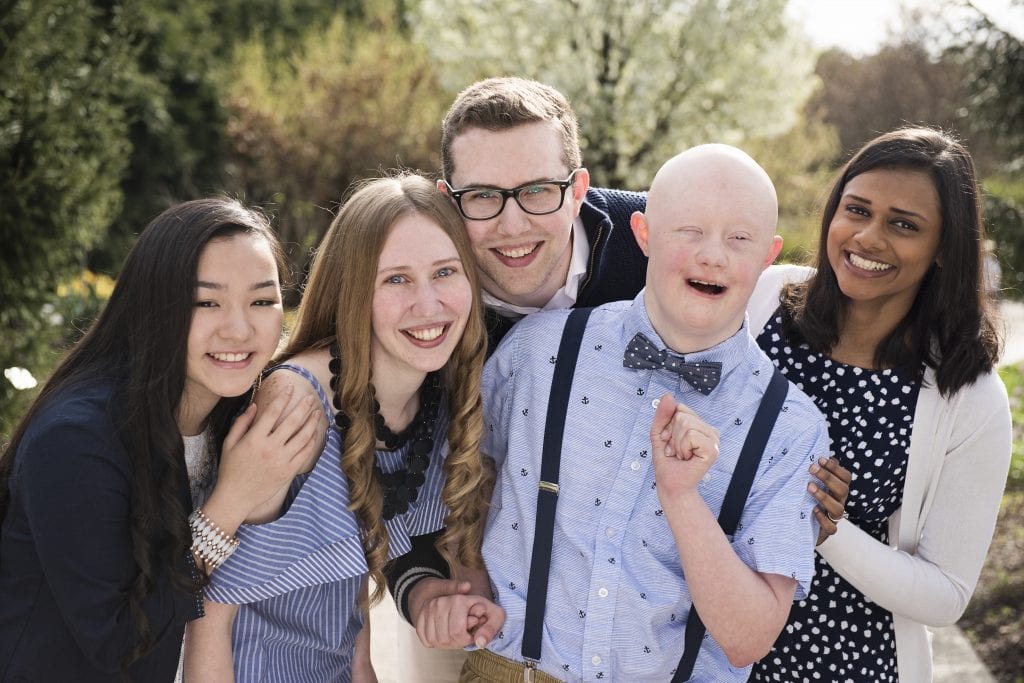
On having a brother with Down syndrome and the origin of Your Special Chef.
I don’t remember very much about the birth of my little brother. I 

I remember my mother’s tears, and I remember seeing my baby brother and thinking that he was perfect, although more yellow than I thought he would be. Then the mantra, “Sam has Down syndrome, which means that he has an extra chromosome. It just means that he takes longer to learn things.” After all, how do you explain trisomy 21 to a three-year-old?
Somewhere between his birth and elementary school, Sam’s diagnosis became a part of my own identity. My job was to protect him and to teach him what I knew about the world. When my first grade teacher asked me for facts about myself, my answer was that I had a brother with Down syndrome. And when she wrote “Down’s syndrome” on the board, I told her that “Down Syndrome” was the preferred spelling.
 |  |


Nevertheless, aside from tagging along to therapy appointments, I don’t have very many early memories suggesting that much was different about my brother. I think that my parents made an effort to make life as normal as possible for me and Seth. They always gave me special attention, signed me up for ballet and oboe and piano classes, built me a custom Victorian dollhouse, and allowed me more independence than I probably deserved. There were, of course, compromises. For years, certain restaurants were off-limits because Sam wouldn’t eat any of the food there. Sam was too fussy for the docent at Monticello, and our family still rarely flies because it’s difficult for Sam to get around on a plane. Though I make no claims to selflessness, I think that having a brother with Down syndrome helped me beat back some of the childish solipsism that would otherwise suggest that I was the center of my parents’ world. There was never any room for complaining, “But Sam didn’t have to do it!” Seth and I learned that fair treatment doesn’t mean equal treatment, and that our differing abilities meant that our parents had different expectations for us.


Seth became an excellent role model for how to champion those with intellectual disabilities. I knew that I valued my brother Sam, but Seth showed me how to extend that affection to those in our community. When Seth was in 6th grade, he invented his own elective to hang out with the students in the life skills classroom. I joined his elective two years after, and 10 years later, our youngest sister Grace is doing the same. For his senior project in high school, Seth self-published a photo book that follows the lives of three individuals with intellectual disabilities. And though he now works in IT, Seth’s gentleness and patience are still evident in his everyday interactions.
I’ve known for years that I wanted to do something to help those with disabilities, but the exact details seemed to change with my moods. At first, I thought that I would make a good physical therapist. After visiting the U.S. Holocaust Memorial Museum as a middle schooler, I was captivated by outstanding questions in medical ethics regarding the treatment of those with Down syndrome. By the time I reached high school, I was tired of my hypothetical future plans for helping those with disabilities, and decided to create Your Special Chef. Its form and features have been evolving over the last six years, but receiving emails from parents and teachers who use the resources is incredibly rewarding to me. I eventually decided that I wanted to study the biology behind Down syndrome and other neurodevelopmental disorders. I received my bachelor’s and master’s degrees in biology, and I’m currently in a Ph.D. program in human genetics at the Johns Hopkins School of Medicine. Although I’m very busy with my research, I hope to continue adding recipes and resources to this site in my spare time.

I occupy a unique position – I have a brother with Down syndrome, and I study mouse models of Down syndrome. I know what it means to have a family member with an intellectual disability, and I know how to read the scientific papers describing the biological causes. Where scientists can approach disorders as molecular puzzles, I am personally invested in the findings. I’m hoping to use this blog to explain scientific papers with relevance to neurodevelopmental disorders using common language. Also look for more articles about adaptive cooking tools and using picture recipes to teach cooking skills!


Photo credit featured image: Kelly Valeri
